The wealth management industry is currently caught in a technological crosscurrent. On one side, there is the undeniable allure of artificial intelligence, machine learning, and vast computational power. We are witnessing an era where complex quantitative investment strategies, from factor modelling to dynamic asset allocation, can be executed with a speed and precision that was unimaginable just a decade ago. Algorithms can ingest macroeconomic calendar data, analyse breaking news, and map historical stock performance in milliseconds. Yet, as a discretionary fund manager standing at the intersection of technology and capital allocation, I see a growing temptation to let the machine simply take the wheel.
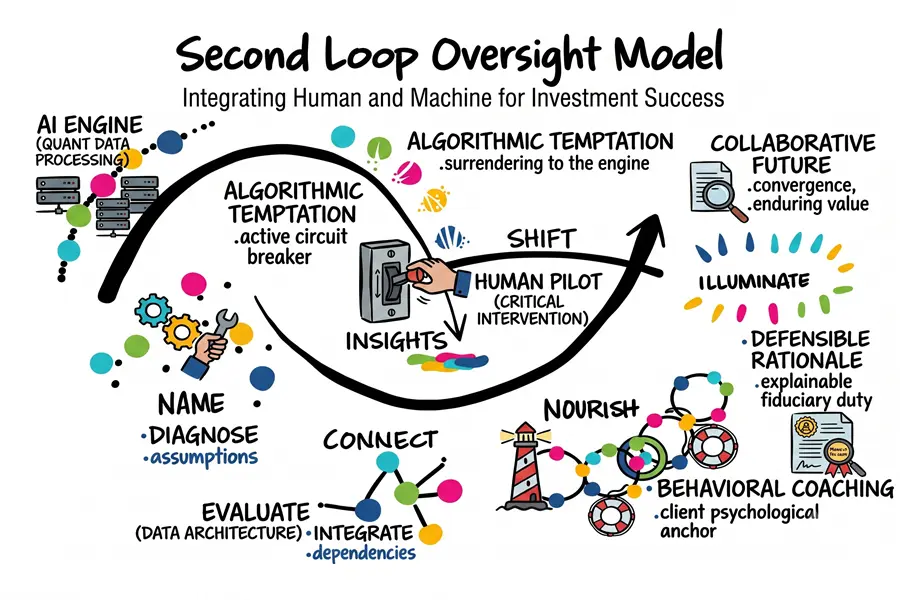
This is a dangerous proposition. The future of investment management is not about surrendering to the algorithm; it is about embracing what I call the ‘Second Loop.’ The Second Loop is the critical layer of human oversight, judgment, and intervention that wraps around artificial intelligence. It is the realization that while AI is an extraordinary engine, it still requires a human pilot to navigate the complex, often irrational realities of the financial markets. For financial advisors, understanding this Second Loop is not just an academic exercise; it is the key to demonstrating enduring value to your clients in an increasingly automated world.
Combating Automation Complacency
As we deploy increasingly sophisticated quantitative models to construct and manage Model Portfolios, the nature of investment risk is fundamentally shifting. Historically, risk was often associated with human error - an emotional trade, a miscalculated spreadsheet, or a failure to anticipate a market rotation. Today, as AI takes on the heavy analytical lifting of parsing Price-to-Earnings ratios, tracking momentum shifts, and identifying smart beta opportunities across the ETF landscape, the primary risk is no longer the machine breaking down. The primary risk is automation complacency.
This phenomenon occurs when human managers begin to over-trust highly reliable systems, rationalizing anomalies and gradually abdicating their responsibility to critically evaluate the outputs. When an algorithm consistently performs well, human nature dictates that we stop paying close attention. But financial markets are not deterministic physical systems; they are complex, adaptive, and driven by human psychology. A machine learning model trained on a decade of quantitative data might be highly adept at recognizing historical patterns, but it fundamentally lacks the contextual awareness to understand a novel macroeconomic shock or an unprecedented geopolitical event.
In the Second Loop, the role of the discretionary fund manager is to act as a permanent, active circuit breaker. We do not just build the quantitative models; we aggressively challenge them. If an AI system signals a sudden shift into a specific growth factor based on short-term momentum, the human manager must validate whether that signal makes sense within the broader, current market regime. Is the algorithm detecting a genuine structural shift, or is it simply overfitting to noise generated by an anomalous news event?
By maintaining a deep, continuous engagement with the underlying data architecture – understanding exactly how the system processes information and connects to its data sources – we prevent the portfolio from blindly following a flawed pattern into a localized market trap. For the financial advisor, this level of scrutiny is paramount. You need the confidence that the Model Portfolios you recommend are not running on autopilot. They must be actively stress-tested by human professionals who understand the limitations of the technology just as well as its formidable capabilities.
Behavioural Coaching as the Ultimate Alpha
While the first aspect of the Second Loop focuses on portfolio oversight, the second aspect is entirely about client oversight. The financial industry often fixates on the pursuit of alpha through superior asset allocation and perfectly timed market entries. However, the most sophisticated Model Portfolio in the world is completely useless if the client panics and liquidates their holdings at the bottom of a market cycle.
Artificial intelligence is exceptionally good at compressing the invisible labour of our industry. It can handle the massive data extraction, the historical scenario planning, and the mathematical optimization required to balance risk and return efficiently. What a machine cannot do is look a nervous client in the eye and talk them off the ledge during a period of severe market volatility.
This is where the true value of the modern financial advisor lies, and it is a value that technology actually enhances rather than replaces. By relying on a discretionary fund manager to handle the rigorous, algorithmic efficiency of portfolio construction and quantitative oversight, the advisor is liberated, freed from the relentless demands of daily market monitoring and given the capacity to focus on the deeply human aspects of wealth management. You become a behavioural coach.
Your role is to deeply understand the client's fears, their long-term aspirations, and their unique emotional triggers. When the market experiences a violent drawdown, the algorithm will unemotionally rebalance the portfolio according to its predefined parameters, but the client will experience real, visceral anxiety. The Second Loop empowers you to step into that moment with conviction. You can assure your client that the quantitative strategy is functioning exactly as designed, carefully managed by human professionals, while you focus on providing the empathy, accountability, and psychological anchor they need to stay the course. In an AI-driven world where asset allocation can be automated, emotional intelligence and behavioural coaching have become the ultimate, un-commoditized alpha.
The Regulatory Imperative of Defensible Rationale
The third pillar of the Second Loop is rooted in the evolving landscape of compliance and fiduciary responsibility. We are entering an era where regulators globally are drawing a hard line on the use of artificial intelligence in finance. The conversation has decisively shifted from theoretical guidelines to enforceable rules, with emerging frameworks demanding demonstrable human-in-the-loop oversight for any high-risk financial decisions.
The era of the algorithmic black box, where client capital is managed by a complex neural network whose decision-making process cannot be explained, is effectively over. It is no longer acceptable to simply have a human passively monitoring a digital dashboard. Regulators, and increasingly, sophisticated clients, demand that the human overseer possesses the timely context, the explicit authority to intervene, and a defensibly documented rationale for approving or overriding an AI-generated action.
As a discretionary fund manager, providing this defensible rationale is a core component of the fiduciary duty. Every adjustment made within our Model Portfolios, whether driven by a subtle shift in a factor model or a broader macroeconomic reallocation, must be transparent and explainable. When we integrate alternative data sets or build out financial event libraries to map macroeconomic indicators to daily market returns, we are essentially feeding the machine its worldview. If a data stream is corrupted or a script miscategorises historical returns, an unsupervised algorithm will blindly execute on flawed premises.
The Second Loop ensures that there is always a tangible thread of accountability connecting the underlying data architecture to the final investment outcome. This rigorous explainability protects you, the advisor. When you sit across the table from a client or respond to a compliance inquiry, you cannot point to an algorithm and say it simply made a suggestion. You must be able to demonstrate that every investment decision is backed by clear, human-validated logic. The Second Loop ensures that the technology serves the fiduciary standard, rather than obscuring it.
The Future is Collaborative
Ultimately, the narrative that artificial intelligence will entirely replace human judgment in investment management is fundamentally flawed. Instead, we are seeing a powerful, necessary convergence. Technology provides the scale, the processing power, and the quantitative rigor, while human professionals provide the context, the behavioural anchor, and the ethical accountability.
The Second Loop is the critical framework that unites these two forces. By managing the technology at the portfolio level and acting as the vital circuit breaker against automation complacency, discretionary fund managers ensure that the quantitative models remain robust, logical, and explainable. This, in turn, empowers you as the advisor to manage the client, delivering the indispensable behavioural coaching that algorithms can never replicate. In this rapidly evolving landscape, the most successful wealth management partnerships will not be those armed with the most complex technology, but those who have mastered the human oversight that guides it.
Irene Bauer