The swarming impact of AI
Diversification is the closest thing our industry has to a religion. Harry Markowitz called it the only free lunch in finance, and for seventy years we have built portfolios, risk ratings and entire business models on that promise.
But there is an assumption buried in that lunch that almost nobody talks about. Diversification works only if the people holding the assets make their decisions independently. Spread your money across a dozen asset classes, and you are still exposed if everyone else holding those assets sells on the same afternoon, for the same reason, using the same logic.
Last week, we argued that AI is driving the cost of replicating investment expertise towards zero. This week we want to follow that thought to its uncomfortable conclusion. If everyone builds their portfolios with the same handful of AI models, trained on the same data and asked the same questions, we do not get a thousand independent portfolios. We get one portfolio, held a thousand times. And when that happens, diversification breaks.
We are already halfway there
The uncomfortable truth is that model portfolios have started to converge well before AI arrived. Waverton Investment Management has pointed out that typical balanced model portfolios across providers now share very similar asset allocations and geographic exposures. The same holdings turn up again and again. Blending two or three providers, it argues, adds little genuine diversification. The driver has been cost: active managers under fee pressure have moved their equity exposure into the same low-cost passive vehicles.
None of this was anyone's plan. It is the natural result of everyone optimising for the same things: low fees, defensible risk ratings, clean due-diligence files and platform availability. When everyone solves the same problem under the same constraints, they arrive at the same answer.
AI accelerates this. It makes portfolio construction cheap, fast and standardised. An adviser who once leaned on a favourite DFM or their own spreadsheet can now ask a large language model to build a risk-graded ETF portfolio in seconds. So can their competitor down the road. So can ten thousand others.
History rhymes: the quant quake of August 2007
We have seen this film before, albeit on a smaller screen. In the first fortnight of August 2007, some of the most sophisticated quantitative equity funds in the world suffered sudden, severe losses, then recovered much of the damage within days. Fundamental managers were largely unscathed. Nothing in the economy explained it.
If you have not read Scott Patterson's The Quants, I recommend it without hesitation. Patterson, then a Wall Street Journal reporter, tells the story of the brilliant mathematicians who built the quant industry, and of the week in August 2007 when their models turned on them. Funds that each believed their strategies were proprietary found they had all been crowding into the same trades. When one began to sell, prices moved against all the others, forcing them to sell as well, and a cascade followed. The lesson was brutal: when everyone needs liquidity at the same moment, there is not enough to go around.
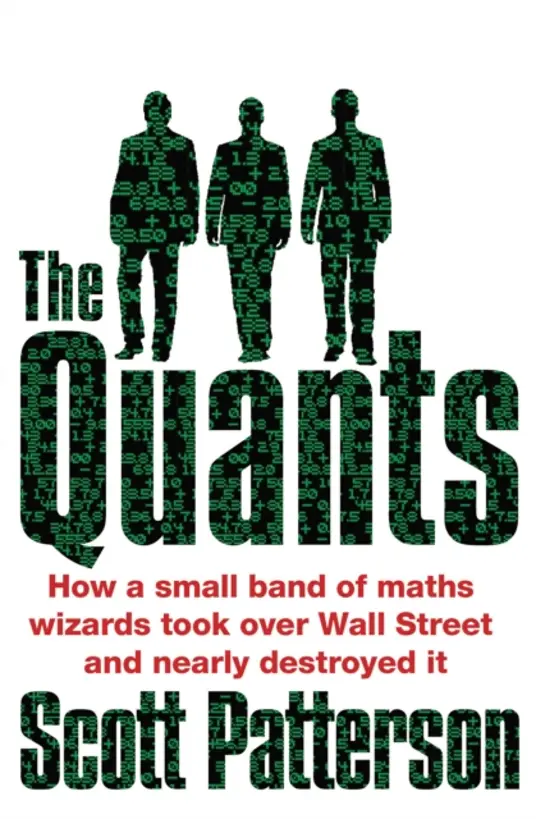
One manager later admitted that the industry had underestimated "how many people were utilizing the same signals", and the lesson the industry took away was about crowding.
Here is the point I want readers to sit with. A widely used AI model is, in effect, a shared signal. It is a common source of views, weights and rebalancing triggers, distributed at enormous scale. In 2007 the crowd was a few dozen hedge funds. In the AI era, the crowd could be every adviser, platform and robo-service in the market.
The regulators can see it coming
This is not a fringe worry. The central banks are already on it. In April this year, Sarah Breeden, the Bank of England's Deputy Governor for Financial Stability, told the Treasury Committee that the Bank is running scenario analysis and simulations on AI risk, with a specific focus on herding that could amplify selloffs in periods of stress. Likewise, in the IMF's October 2024 Global Financial Stability Report, market participants ranked herding and market concentration among the leading risks of large-scale AI adoption.
More relevant to readers of this newsletter, IMF found that AI-driven ETFs showed elevated turnover during the March 2020 turmoil, consistent with AI amplifying herd-like selling under stress. In July, the IMF went further and told central banks to prepare for AI-driven correlated behaviour before a crisis, not after one.
So, the official sector has identified the mechanism, but its attention is fixed on trading desks and execution algorithms. The bigger exposure may lie somewhere else.
Herding moves upstream
The regulators are watching where trades are executed. The herding I worry about starts earlier, at the point where portfolios are designed.
Think about how an AI-assisted portfolio gets built today. The capital market assumptions come from a model trained on broadly the same public data as every other model. The optimiser is one of a handful of standard approaches. The ETF universe is the same shortlist of liquid, low-cost funds. The prompts are similar too, because advisers are all asking some version of: "Build me a balanced, globally diversified ETF portfolio for a client with a risk score of 5."
The outputs converge. No one has to coordinate anything. Each adviser and DFM believes they have made an independent, evidence-based decision, and in a narrow sense they have. But collectively they have outsourced their judgement to the same source.
The convergence does not stop at the initial allocation. If the same models also generate the rebalancing signals, the tactical tilts and the de-risking triggers, then thousands of portfolios will move in the same direction on the same day. On a calm day nobody notices. In a crisis, it is the August 2007 cascade repeated across the mass market instead of a few dozen hedge funds.
The sacred cow falls
This is where the theory starts to come apart. Every tool we use to measure diversification, from correlation matrices and the efficient frontier to volatility-based risk ratings, is estimated from history. That history was produced by a market of investors who disagreed with each other. Some bought while others sold, and different time horizons, mandates and temperaments acted as a natural shock absorber.
If AI removes that disagreement, the history no longer describes the future. Correlations measured in a world of independent decision-makers will understate the correlations we get once decision-making converges. The difference will be smallest when markets are calm and largest in a sell-off, which is exactly when diversification is supposed to work.
This calls for a new way of thinking about risk. A portfolio can be well diversified across assets and still dangerously concentrated in the way decisions about it are made. None of our standard risk metrics captures that second kind of concentration. A Level 5 portfolio held by ten thousand investors who will all rebalance at the same moment is not the same risk as a Level 5 portfolio held by ten thousand investors acting independently, even though the numbers on the factsheet look the same.
Will personalization come to the rescue?
In fairness, there is a strong counterargument, and it comes from the Bank of England itself. In its 2025 paper on AI and financial stability, the Bank noted that AI could just as easily reduce herding. If managers use AI to tailor strategies to each individual client, portfolios will diverge rather than converge, because investors will no longer hold the same assets.
I agree, and that is precisely the point. AI does not determine the outcome. It amplifies whatever we ask it to do. Used as a cheap way to produce the industry-standard balanced portfolio, it will produce a monoculture. Used as a tool for genuine personalisation, reflecting each client's tax position, income needs, existing holdings, values and behavioural tendencies, it could make portfolios more diverse than ever.
Which of these futures we get depends on choices that firms are making now, often without realising they are making them.
What portfolio architects should do now
If you build or select portfolios for clients, here are four practical steps.
- Diversify the process, not just the assets. The most important diversification decision is now the source of your views. Combine independent views with market equilibrium using frameworks such as Black-Litterman. Set your own weight bounds rather than accepting an optimiser's defaults.
- Measure your own crowding. Ask a general-purpose AI to build your model portfolio from a standard prompt, then compare the result with what you actually run. If the two are nearly identical, you are part of the crowd. Do the same comparison against your peer group's published allocations.
- Stress-test for correlated selling, not just falling prices. Standard stress tests ask what happens if markets fall 20%. Add a second question: what happens to liquidity if everyone running a similar model rebalances on the same day?
- Treat a different view as an asset. This links back to last week's article. When construction is a commodity, judgement becomes the scarce resource, but judgement only has value when it differs from everyone else's. A CIO who simply agrees with the model adds cost, not value.
Diversified assets, identical minds
Diversification was never really about owning lots of different things. It was about holding assets whose fortunes do not all depend on the same thing at the same time. For most of financial history, the variety of human opinion quietly did a great deal of that work.
AI could remove that variety without anyone noticing. Portfolios would look diversified on paper and behave like a single bet under stress. The regulators are beginning to model the risk at the trading level. Those of us who design portfolios need to confront it at the construction level, before the next stress test is set by the market rather than by the Bank of England.
The next crisis may not come from investors failing to diversify. It may come from everyone diversifying in the same way. A widely used AI model is, in effect, a shared signal. It is a common source of views, weights and rebalancing triggers, distributed at enormous scale.
In 2007 the crowd was a few dozen hedge funds. What if that crowd multiplies to every adviser, platform and robo-service in the market?
Until next time.
Allan Lane